Matrix is a rectangular array of numbers, symbols, points, or
characters each belonging to a specific row and column.
Example:
\[
\begin{bmatrix}
1 & 2 & 3 \\
4 & 5 & 6
\end{bmatrix}
\]
a determinant is a number associated with a square matrix, symbolized by \(|A|\) or \(det(A)\). it can be used to inverse the
matrix if it’s value is none zero.
Equation :
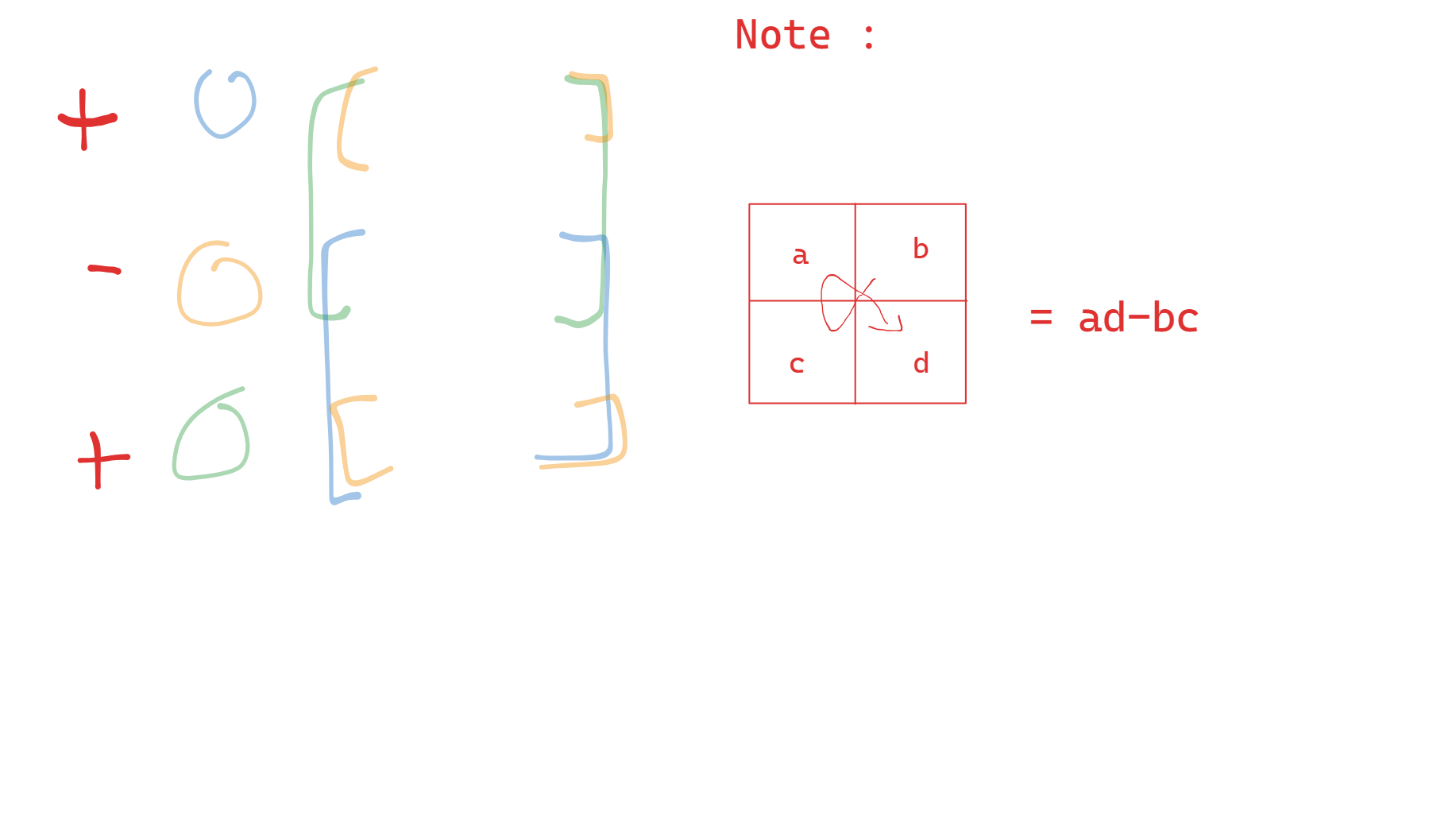 \[
⇒ det(A) = a.e.i + b.f.j + d.d.h - c.e.g - b.d.i - a.f.h
\]
- Note :
\[
⇒ det(A) = a.e.i + b.f.j + d.d.h - c.e.g - b.d.i - a.f.h
\]
- Note :the 2x2 matrix used in the multiplication of \(a\) or \(d\) or \(g\) is called the minor of said element, where is Minor of element \(a\) is a 2x2 matrix made by deleting the row and column of the in reference element. it is usually denoted as \(M_{ij}\)
a cofactor is a property of an element of a matrix, denoted as \(A_{ij}\) or \(C_{ij}\) and is defined as follows : \[C_{ij} = (-1)^{i+j} . M_{ij}\] where is : - \(C_{ij}\) is the cofactor value - \(M_{ij}\) is the minor of element \(a_{ij}\)
the cofactor of \(a_{32}\) would be :
\[ C_{32} = (-1)^{3+2} . \begin{bmatrix} 5&3\\1&2 \end{bmatrix} \] \[ C_{32} = -1 . -7 \] thus \[ C_{32} = 7 \]a adjoint is a modification of a matrix used to calculate other aspects of said matrix like their inverse. Formula for a 2x2 matrix : for :
\[ A = \begin{bmatrix} a & b \\ c & d \end{bmatrix} \]we have : \[ adj(A) = \begin{bmatrix} d & -c \\ -b & a \end{bmatrix} \]
Formula for a 3x3 matrix : for : \[ A = \begin{bmatrix} a1&b1&c1\\ a2&b2&c2\\ a3&b3&c3 \end{bmatrix} \] replace each element to it’s respective cofactor \[ A'= \begin{bmatrix} a'1&b'1&c'1\\ a'2&b'2&c'2\\ a'3&b'3&c'3 \end{bmatrix} \] then we just transpose the matrix (which means to flip it) : \[ adj(A) = \begin{bmatrix} a'1&a'2&a'3\\ b'1&b'2&b'3\\ c'1&c'2&c'3 \end{bmatrix} \]for a matrix \(A\) with a non zero determinant, we can have a inverse matrix of \(A\) called \(A^{-1}\).
for \(A\) a Matrix we have \(A^{-1}\) as it’s inverse with the formula :
\[ A^{-1} = {1\over{det(A)}}\times adj(A) \]a matrix may have some unknown values, and there are many methods to solving for these variables. some exceptionell cases need to be known to handle these methods
Newton’s Binomial Formula is applicable on 2 Matrices \(A\) and \(B\) if and only if :
Gaussian elimination is a methide to solve a system that relies on eliminating variables from the equations to create a Triangular Matrix
this involves doing operation between rows until we get the desired result
we will keep \(R_1\) as a pivot used to eliminate the x variable from other rows
\[ S = \begin{cases} x + 2y + 2z= 2 ⇒ R1 \\ y-4z=-3 ⇒ R_2\leftarrow R_2-R_1\\ -y+2z=2 ⇒ R_3\leftarrow R_3-3R_1 \end{cases}\]we will keep \(R2\) as the pivot to remove the variable \(y\) from the last row
\[ S = \begin{cases} x + 2y + 2z= 2 ⇒ R1 \\ y-4z=-3 ⇒ R_2\\ -2z=-1 ⇒ R_3\leftarrow R_3+3R_2 \end{cases}\] with this replacing we know that \(z = \frac{1}{2}\) which we can replace in the second row, yielding the result of \(y\) then repeat the process for the firstrow.